
Consumer data protection and privacy have always been important concerns for organizations that process personal customer data. Responding to the increased incidence of data breaches worldwide, governments are also focusing on consumer data security in the form of new legislation. Organizations are required to comply with these continuously evolving regulations while staying innovative and developing their products and services.
|| GDPR and CCPA
The GDPR, which came into effect on 25 May 2018, is one of the world's most comprehensive data protection laws to date. Due to the lack of comprehensive federal privacy law in the U.S., the CCPA (California Consumer Privacy Act) is considered the most crucial legislative privacy development. The two regulations bear similarities concerning their definition of terminology, the establishment of protections for individuals, and the inclusion of rights to access personal information.
How the GDPR Applies to Optimove
The GDPR defines two main entities: “data processor” and “data controller”. The definitions of, relationships between and responsibilities of data controllers and data processors are specified with the goal of protecting the rights of EU citizens whose personal data is stored or processed. The GDPR describes the particular types of security, IT, and administrative activities that might be considered necessary for handling personal data, including encryption, documentation, and taking measures to ensure the integrity, confidentiality, availability, resilience, assessment, and post-incident recovery of processing systems and services.
- Data controller (You) – Controllers bear the primary responsibility for GDPR compliance. As a data controller, you manage customer data, access controls, and authentication.
- Data processor (Optimove) – Any entity that processes personal data under the controller’s instructions. As a data processor, we provide cloud-based software, services, infrastructure, and support. As a data processor, we are obliged to make our best efforts to protect your customer data and enable you to fully meet GDPR requirements.
Prepared for the GDPR
At Optimove, we are committed to full compliance with everything required by the GDPR, as well as taking additional precautions to ensure the complete security and privacy of your customers’ data. Optimove has always focused on data protection and regulatory compliance, and we are constantly looking for better ways to secure data in transit, at rest, and in use. We strive to meet the demands of our client base of more than 300 companies from more than 25 countries to comply with all relevant regional laws and regulations.
All of Optimove’s applications and data reside, on cloud, in multiple datacentres (multi region) belonging to Amazon Web Services (AWS), Google Cloud Platform (GCP) and Microsoft Azure. Leveraging cloud providers and services enables us to offer maximum performance for predictable workloads and greatest elasticity for burst workloads.
How Optimove Complies with the GDPR
GDPR Requirement |
How Optimove Complies or Enables Your Compliance |
|---|---|
|
Information and transparency
|
Each Optimove instance is configured and documented with the help of “workbooks and procedures”. Workbooks and procedures describe the features and processes used to store, process and protect customer data.
|
|
Access to data
|
All personal data for a data subject is available for reporting using our Customer Explorer and Customer 360 interactive reports, as well as various functions of theOptimove API.
|
|
Rectification of data
|
Using the Optimove Batch Data Process, you can change an individual’s personal data. Overriding data retention laws or other legal requirements may prevail.
|
|
Erasure of data
|
Data purge (in the sense of complete and irrevocable deletion or erasure of an individual customer’s data) is possible using both Optimove web interface and theOptimove API, which you can use to implement your requirements. Purging of customer data must be explicitly indicated by you for specific customers by specifying each customer’s ID. See below for details about implementing customer data erasure.
|
|
Restriction of processing
|
Optimove admin users can restrict data processing of an individual customer by purging their data from the Optimove database as described below.
|
|
Data portability
|
All personal customer data in Optimove is available for reporting, export/download and access via functions of theOptimove API.
|
|
Data breach notification
|
Data breach notification handling for Optimove as a data processor is described in the Data Processing Agreement (DPA), Section 3.4. For your own processes, the tools for read access logging can be used.
|
|
Privacy by design
|
Privacy by design is inherent in all Optimove products, as data protection and privacy have always been an important element in our products and services. While Optimove’s software and systems have been developed based on data protection principles and best practices, you are still responsible for configuring and using them appropriately.
|
|
Privacy by default
|
Optimove products meet the privacy-by-default requirement of GDPR, namely that technical and organizational measures are in place to ensure that, by default, only personal data necessary for a specific purpose is processed.
|
|
Consent
|
You are responsible to demonstrate end user consent.
|
|
Automated decisions
|
Optimove admin users are able to prevent the making of automated decisions regarding an individual customer by purging that customer’s data from Optimove as described below.
|
|
Cross-border data transfer
|
You can decide which data center location your organization will use for hosting your Optimove instance: Frankfurt, Germany or Washington, DC. Optimove does not transfer your customer data out of the country in which it is hosted.
|
Implementing the Right to Erasure (or, the Right to be Forgotten)
As discussed in Article 17 of the GDPR, the right to erasure, also known as ‘the right to be forgotten’, obligates data controllers to erase the personal data of individuals upon request, without undue delay. To this end, Optimove provides two facilities that you can use to completely and permanently delete all data related to a particular individual from all Optimove systems:
- By using the RemoveCustomerPIIfunction of the Optimove API.
- By manually uploading a CSV file using the User Settings web interface. This single-column CSV file (which does not require a column header row) should contain only a list of the Customer IDs used in Optimove that you wish to erase.
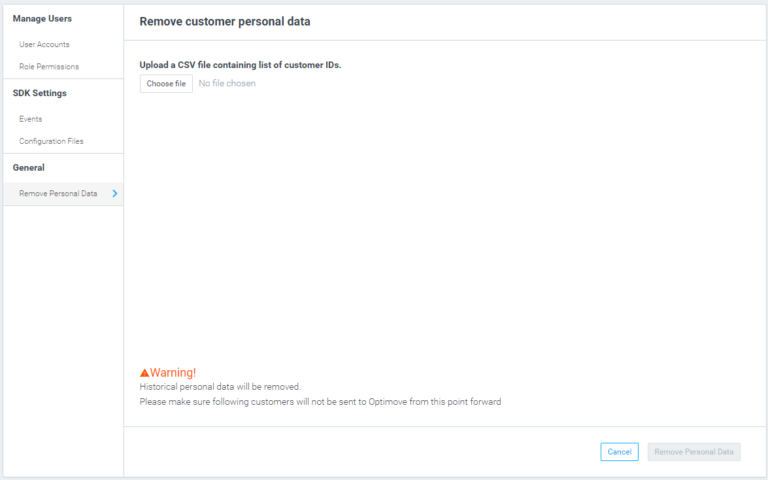
- During the onboarding process, you will need to notify Optimove which fields should be marked as Personal Identifiable Information (PII).
- After onboarding, you must contact your CSM to mark new fields or unmark existing ones as PII.
- It may take up to 72 hours from the original erasure request until all data related to a particular customer is completely removed from all Optimove systems.
- Deleting a customer’s data will erase all personally identifiable data from Optimove (both current and historical data). However, in order to maintain the integrity of campaign and application usage analytics, aggregated anonymous data will not be amended when a user is deleted (for example, a campaign’s “increase in” metric value will not be recalculated once a user is deleted). This is not a problem vis-à-vis the GDPR because this aggregated data cannot be connected back to an individual.
- You are obliged to make sure that no data from any such customers are delivered to Optimove in the future (e.g., as part of the Optimove Batch Data Process).
Frequently Asked Questions about Optimove and the GDPR
- Access to data – All personal data stored by Optimove relating to every data subject is available to you via the Customer Explorer and Customer 360 pages, as well as via various functions of the Optimove API.
- Rectification of data – Using the Optimove Batch Data Process, you can change an individual’s personal data. Overriding data retention laws or other legal requirements may prevail.
- Erasure of data – Data purge (complete and irrevocable deletion or erasure) is possible as described above.