
What is a Customer Journey?
A customer journey tells the story of a customer’s experience interacting with a company, starting with the initial contact and continuing through all subsequent interactions, via all touchpoints. A marketer’s job is to understand the various points at which customers engage with a brand, its products or services, and its marketing messages, and to ensure the most successful usage of each such opportunity.
The Traditional, Flowchart-based Approach
Most marketers – and the products that help them manage customer journeys – use a map-based, or flowchart-based, approach. This framework for customer journey mapping is one that enables marketers to plan and take advantage of customer journeys in order to maximize customer engagement and satisfaction. The best such flowcharts are built using data-driven research that can express the most important stages of the most common journeys and how to best engage the customer at each one.
- Control and visibility – The marketer knows exactly what each customer will get at each point of the process flow, and in what order because the marketer designed it in advance.
- Easier internal communication – Because the flowchart can be shown to other people in the organization visually, it is easy to explain the plan and communicate it with other people in the company.
- Journeys are static – Pre-planned journeys can cover common paths that customers take, but they cannot address unplanned or unusual customer behavior.
- Limited flexibility – Pre-planned journeys cannot cover every scenario, inevitably leaving many customers behind, or treated too generally, or even incorrectly.
- Relies heavily on the marketer’s inherent abilities – Only the most advanced marketers will be able to foresee and visualize the huge number of different journeys to adequately cover all bases.
- Assumes a single journey for each customer – It is difficult to manage, modify or combine multiple journey maps, even though many customers shift behavior from one path to another during their journey.
A Potential Break in the Customer Journey
The flowchart-based approach to customer journeys certainly has its uses. For example, during the brief “incubation” period of new customers, the small amount of variability in most customers’ activities allows the marketer to address the majority of new customers with a handful of static journey maps.
- A customer becomes part of an automated journey, such as a post-purchase one, and before the journey has been completed, the customer no longer qualifies for it. However, because customers are locked into the journey, they continue to receive automated messages. This could happen if, for example, the purchase was canceled or returned.
- A customer, who is part of one automated journey, becomes eligible for another customer journey and begins receiving messages from both journeys, or more.
- A marketer failed to anticipate every customer behavior, and the campaigns along the customer journey no longer reflect the current wants and needs of the customer.
Creating Infinite Customer Journeys
Optimove embodies a far more comprehensive approach: instead of pre-planning the various journeys that a customer might take, this approach focuses on dynamically segmenting very similar customers into many small target groups, which you can define on any combination of “behavioral DNA” factors, including:
- Lifecycle stage
- Customer attributes
- Specific website/app activities/behavior
- Spending patterns (amount, frequency)
- Product preferences/affinities
- Response history to previous campaigns
- Predicted customer lifetime value and propensity to churn
- Dynamic and adaptive – Because customers are treated based on the Target groups in which they are presently located, each customer’s journey continuously adapts itself to changes in behavior.
- Easy to scale and evolve – By simply adding more and more Target groups – and the most effective communications for each – the number and sophistication of the customer journeys handled can increase rapidly, even exponentially, without having to re-engineer anything that was built before.
- Greater customer coverage – Focusing on customer Target groups allows you to easily cover hundreds of different customer segments/events/scenarios, without being limited to imagining and planning out certain paths in advance.
- Higher-volume customer marketing – Because no customer is left behind, this approach can easily blast relevant messaging to every customer, at every point in the journey. There is no need to limit treatments to particular junctions on particular pre-planned paths.
Visualizing the Differences
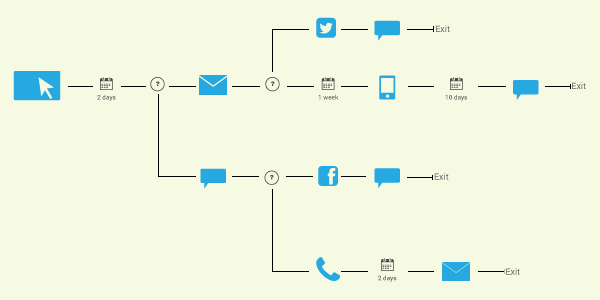
The problem with this type of simple journey map is that many customers will not follow it exactly, rendering it somewhat (or totally) irrelevant to those customers. To make it more relevant to more customers, the marketer needs to continually add more and more nodes and branches to the map. Covering just a few more common customer journeys will quickly force even the smartest and most motivated marketer to create an exponentially more complex flowchart:
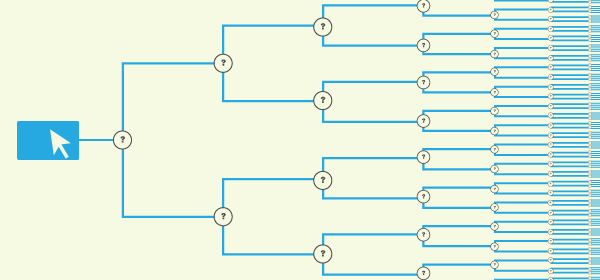
In theory, such an approach could possibly cover many of the relevant customer journeys, but in reality, this is impractical: devising, managing, and evolving such a complex tree is simply impossible. This is especially true when one considers that it would be necessary to include journeys where a customer backtracks to an earlier stage, repeats stages in a loop, and so forth.
Let’s visualize how this works:
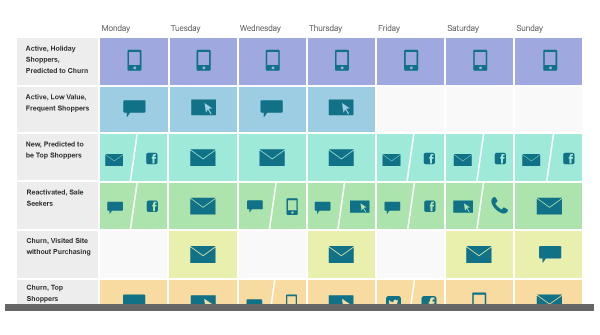
The left-most column in the above matrix may contain dozens or hundreds of very specific Target Groups. Examples may include:
- Registered less than a week, no purchases, browsed handbags
- Spent more than $500 to date, but never responded to a previous campaign
- Played poker in the last week and lost, with a predicted future value greater than $200
- Predicted to churn, bought two or more ski-department products in the past
- Top 10% of all spenders to date, but made no purchase during last 60 days
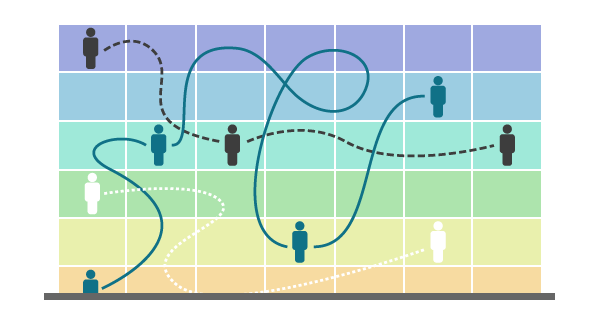
This approach is infinitely more flexible, and therefore infinitely more powerful. You begin by starting with a limited number of customer Target Groups, and the messages that each will receive to encourage them to take a desired action. As time goes on, you will define more and more of these Target Group-campaign pairs to ensure that more and more customer journeys are covered. By including predictive-based Target Groups (such as “likely to churn” or “expected to purchase shoes”), you can directly impact behavior when it matters most, or create a fantastic experience by anticipating the paths that a customer will probably take!
Conclusion
While focusing on customer journeys as a means of improving customer engagement, satisfaction and long-term loyalty are gaining traction among B2C marketers and there are two very different methodologies of how to approach it.
- The static, flowchart-based approach offers clearer visibility into what the marketer has planned, but it is severely limited in how many actual customer journeys it can efficiently address. The flowchart-based approach is also far more difficult to maintain, adapt and expand, although it can be useful to manage typical new-customer journeys.
- Optimove’s smart orchestration engine and target group-based approach, allow you to easily and dynamically address an infinite number of different customer journeys, by focusing on customer Target groups and predicted customer behavior, instead of hard-coded, pre-conceived paths. This more sophisticated approach provides greater and more accurate customer coverage, with greater flexibility and adaptability. In fact, there is no other practical way to manage the infinite customer journeys that are, quite simply, a fact of life.