
Churn Factor is the ratio of the number of days since the customer's last activity to the average number of days between customer activities in the past:
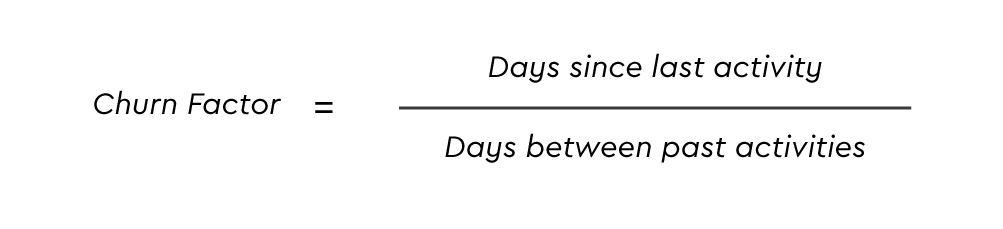
Marketing professionals use the Churn Factor to gauge churn: the higher the churn factor, the higher the chances a customer has already churned and will not return. This indication provides more insight than simply looking at how long it has been since the customer last acted, a metric that doesn’t mean much without context.
Example:
Let's compare Cathy and Mike, two hypothetical customers, to understand why Churn Factor is so important.
Here is Cathy's activity history:

She made her first purchase 240 days ago. She made her last purchase 60 days ago, and she made four purchases three months before the last purchase. Based on this information, we can calculate Cathy's Churn Factor:

Cathy's churn factor is 1, which means she will make another purchase soon.
Let's look at Mike's activity history:

Mike's first purchase was 202 days ago. His last purchase was 90 days ago. He has also made four purchases.
Now we can use the above formula to calculate Mike's Churn Factor:

Mike’s churn factor is 2.4, meaning that his next activity is taking 2.4X longer than expected.
The conclusion is that looking at recency without taking frequency into account can lead to inaccurate personalization and ineffective campaigns.
When to use Risk of Churn and when to use Churn Factor
Churn Factor is a parameter in determining the "Risk of Churn." Churn Factor is calculated on a customer level. Risk of Churn is a predictive metric that takes into account many different factors of the customers' behavior.
Marketing professionals often use these selection criteria together or interchangeably to create more precise target groups or analyze segments' behaviors. Read more here.
- Read more about this topic in this article: Identifying and Reengaging Customers at Risk of Churn
- Read more about this topic in our blog post, Defining Churn: It’s Not a Matter of If, but When